Gas Water Heater Planning: Venting, Combustion, and Recovery
A gas water heater is a combustion appliance, so a sound replacement plan reaches beyond tank dimensions. Fuel type and supply, vent design, combustion air, draft or fan operation, clearances, drainage, and carbon-monoxide protection all need attention. Storage gas models can recover hot water quickly, but the correct choice depends on rated delivery and a safe, compatible installation—not burner size viewed in isolation.
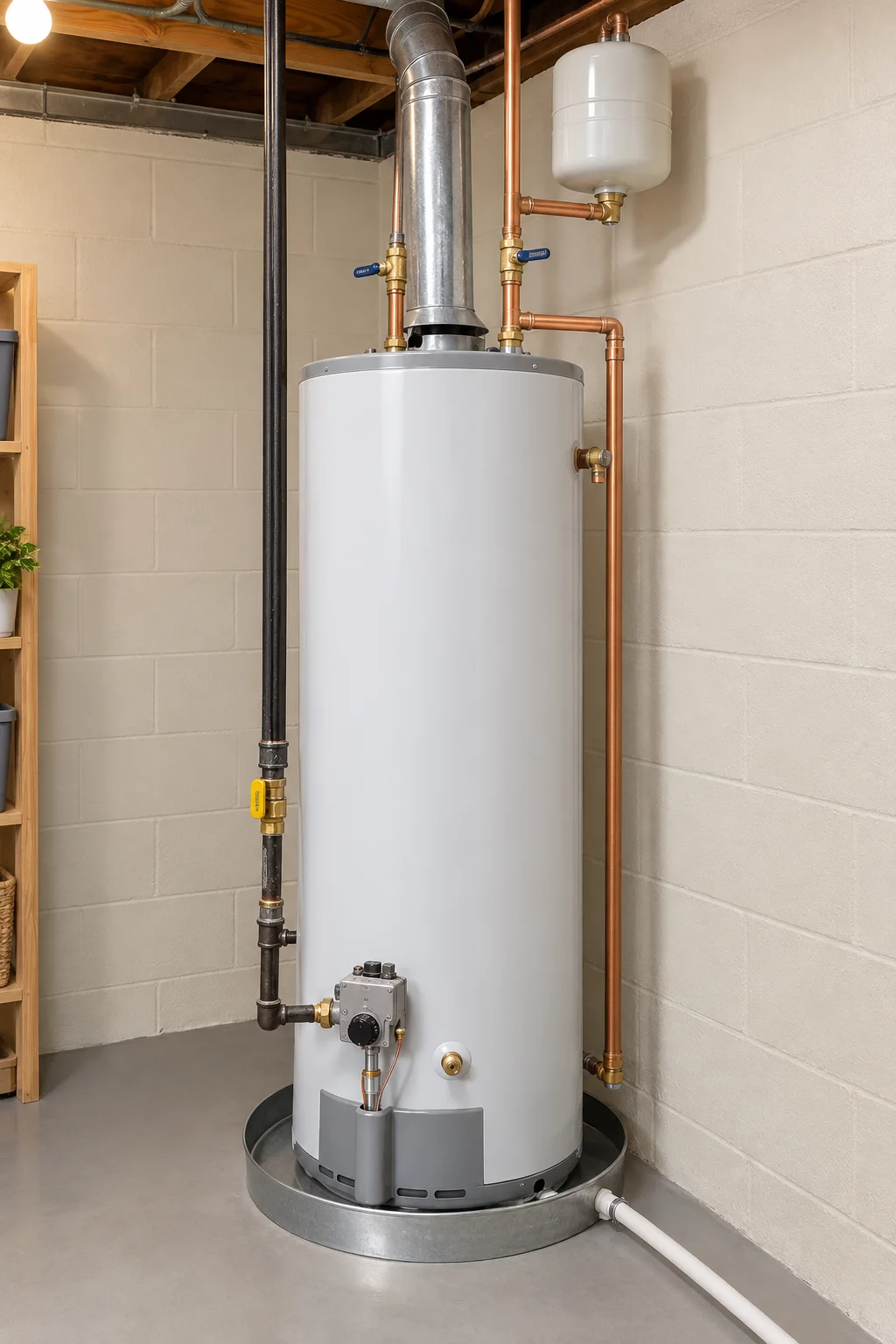
Combustion is a system
Fuel supply, air, vent materials, termination, appliance controls, and room conditions must work together.
Recovery supports storage
First-hour rating joins tank storage with burner recovery to describe peak delivery.
Safety requires expertise
Gas piping, combustion setup, vent changes, and relief-valve work are not homeowner projects.
Fuel and vent type must match the appliance
Natural gas and propane appliances are not casually interchangeable. The data plate, controls, burner components, regulator arrangement, and supply pressure must be appropriate for the fuel. Existing pipe capacity also needs review when input changes or other appliances share the line. A licensed professional should perform and test fuel-gas work.
Atmospheric, power-vented, direct-vent, and condensing designs move combustion products differently. Their vent material, diameter, slope, length, fittings, termination, and combustion-air provisions follow the listed appliance instructions and code. An old vent is not automatically reusable. Chimney condition and shared venting deserve particular review when another appliance is removed or changed.
Combustion air and house pressures
A burner needs a dependable air supply. Tight construction, a small utility room, closed doors, exhaust fans, fireplaces, and other fuel-burning appliances can affect available air or draft. A professional assessment considers the room and the whole combustion arrangement instead of assuming a nearby grille solves every condition.
Carbon-monoxide alarms should be installed and maintained according to local requirements and manufacturer directions, but alarms do not replace correct installation and service. Soot, scorching, repeated shutdowns, unusual burner behavior, or a vent problem calls for prompt professional evaluation. Never bypass a safety control to keep the appliance running.
Storage, burner recovery, and peak demand
Tank labels such as 30, 40, 50, 65, and 80 gallons can organize comparisons, but they do not establish a universal number of occupants. First-hour rating combines usable stored hot water with the amount the burner can recover during the first hour. That figure should be considered alongside showers, tub fills, laundry, and dishwashing that occur close together.
A smaller tank with stronger recovery may behave differently from a larger tank with slower recovery. Incoming-water temperature, distribution length, fixture flow, sediment, setpoint, and controls also influence what reaches the tap. Increasing temperature is not a capacity remedy because it raises scald risk. Sizing and delivery problems deserve a safer technical review.
Efficiency and condensing details
UEF supports comparisons among models in the same draw-pattern bin. It should not be presented as a universal percentage reduction in fuel bills or compared across fuels without context. Household demand, utility rates, standby conditions, piping losses, and installation all affect actual cost.
Some high-efficiency gas designs condense water vapor from flue gases. Those appliances require approved corrosion-resistant venting and condensate disposal, and sometimes neutralization, freeze protection, or a condensate pump. A high rating does not erase space, termination, service-access, or maintenance requirements.
Recognize emergencies and plan maintenance
If you smell gas, leave the building without operating switches, phones, flames, or anything that could create a spark. Call the gas utility or emergency services from outside and follow their directions. Do not return until authorized. Do not search for the leak or try to relight the appliance.
Routine professional service may include inspection of combustion, venting, safety controls, leakage, and tank condition as applicable to the model. Owners can watch for water around the unit and follow accessible manufacturer care instructions, but gas, vent, burner, electrical, and temperature-and-pressure relief work belong with qualified professionals. Tank, parts, and labor warranties are separate and model-specific.
Frequently asked questions
Can a new gas water heater use the old vent?
Possibly, but never by assumption. Appliance category, vent material, size, route, chimney condition, termination, and other connected appliances must be checked.
What should I do if I smell gas?
Leave immediately, avoid switches and ignition sources, and call the gas utility or emergency services from outside. Follow their directions and do not re-enter until authorized.
Does a higher burner input always solve shortages?
No. First-hour rating, tank storage, fuel and vent capacity, peak use, controls, and installation conditions all matter.
Can I convert a natural-gas model to propane myself?
No. Fuel conversions, where specifically permitted by the manufacturer, require correct listed components, setup, leak testing, and qualified professional work.
Is a higher UEF a guaranteed fuel-bill reduction?
No. Compare UEF within the relevant draw bin, then consider usage, rates, piping losses, maintenance, and installation.