High-Efficiency Water Heating: Read Ratings in Context
Efficiency starts with how a water heater produces and stores hot water, but the rating is only one part of a durable choice. Hybrid heat pump, condensing gas, conventional storage, and tankless equipment solve losses in different ways. The right comparison keeps UEF in its test context, checks whether the building can support the technology, and protects the amount of hot water available during the household’s busiest period.
Ratings need context
Compare UEF among appropriate models in the same draw-pattern bin rather than as a universal fuel-cost score.
Efficiency changes installation
Heat pump and condensing technologies add air, drain, vent, electrical, space, or service requirements.
Delivery still matters
An efficient unit must also satisfy peak demand through suitable storage, recovery, or flow capacity.
What UEF can—and cannot—tell you
Uniform Energy Factor reflects standardized testing of water-heater energy performance. Draw-pattern bins matter, so useful comparisons place models in the applicable bin and consider the same fuel and technology context. A larger number by itself is not a universal forecast of annual cost, a savings promise, or proof that unlike fuels will cost the same.
Local utility rates, household draw timing, incoming-water temperature, distribution losses, recirculation controls, selected operating mode, and maintenance affect actual energy use. Ask for the exact model number and rating rather than relying on a family name. Efficiency should be considered with first-hour rating for tanks or flow performance for tankless units.
Heat pump water heaters reduce resistance-element use
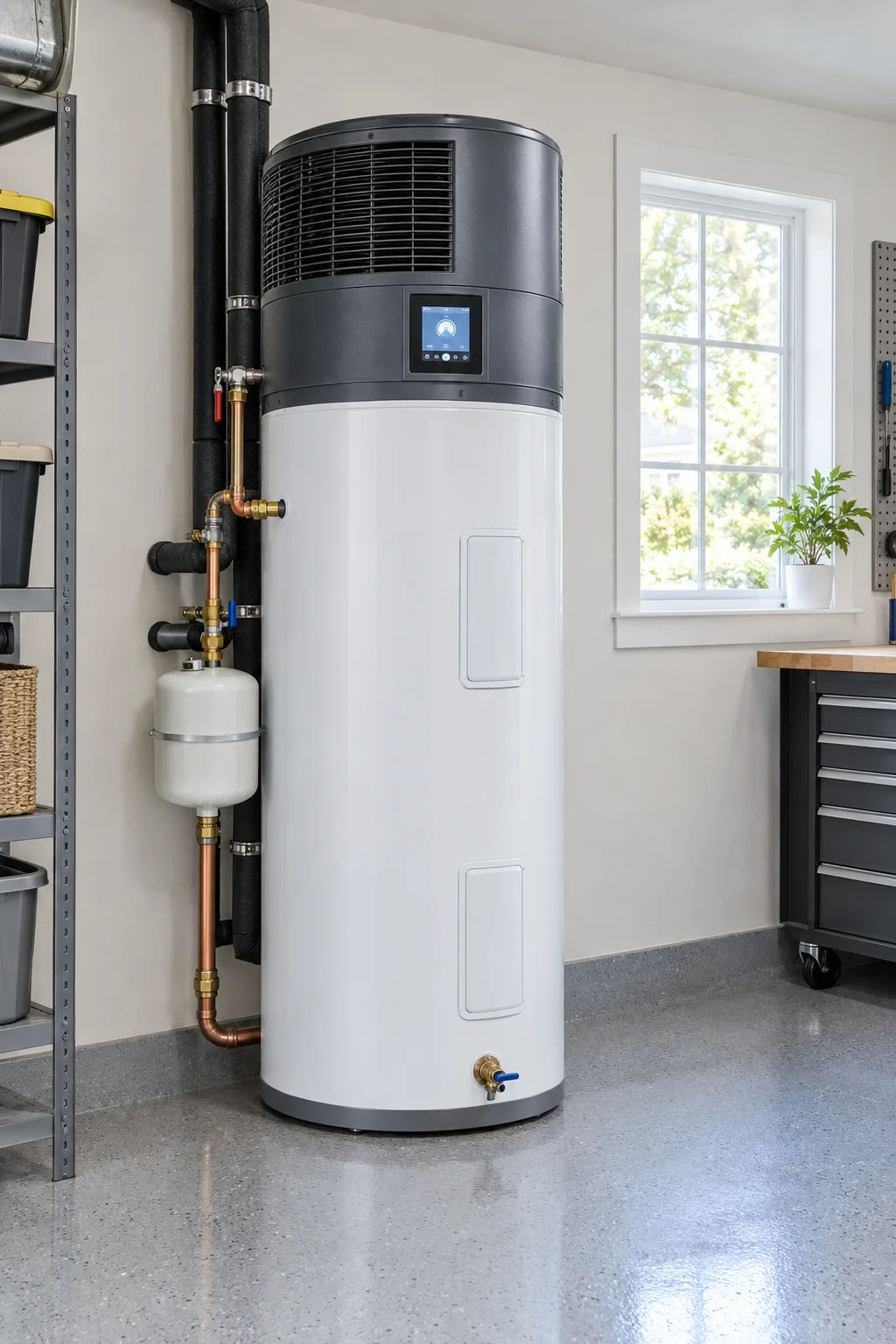
A hybrid heat pump water heater transfers heat from surrounding air into stored water and generally retains resistance elements for backup or selected modes. It is a domestic-water appliance, not a space-heating heat pump. Room air volume, clearances, filter access, and the effect of cool discharge air must be assessed.
The compressor and fan add operating sound. Moisture removed from the air requires a condensate drain or properly planned pump. Mode choices can trade lower energy use for different recovery behavior; labels vary by manufacturer. Electrical specifications and panel capacity still need verification even when replacing another electric tank.
Condensing gas and tankless pathways
Condensing gas equipment captures more heat from combustion products, creating acidic condensate that needs approved disposal and sometimes neutralization. It also requires listed vent materials, proper termination, fuel capacity, combustion setup, and service access. Existing venting may not be compatible even if the old and new units use the same fuel.
Tankless equipment avoids continuous tank standby loss but must generate heat as water flows. Temperature rise and gallons per minute determine simultaneous delivery. Gas models can require substantial input and vent changes; electric models can require large electrical capacity. Efficiency does not excuse an undersized fuel line, service, circuit, or flow selection.
Storage and recovery remain part of efficiency
Illustrative storage sizes—30, 40, 50, 65, and 80 gallons—do not map reliably to a set number of people. First-hour rating combines available storage and recovery under test conditions. Compare it with actual overlapping showers, bathing, laundry, and kitchen use, not an occupancy shortcut.
Piping insulation where appropriate, sensible fixture flow, repaired leaks, and well-controlled recirculation can reduce distribution waste. Raising the tank temperature to imitate extra capacity is not recommended because of scald risk. A professional can evaluate delivery, safe temperature control, and whether storage or recovery should change.
Judge lifetime fit, not one label
A proposal should identify equipment cost and installation scope separately: venting, drains, pan, electrical or fuel work, permits where required, and removal may differ. Maintenance access matters because neglected filters, condensate components, scale, sediment, or combustion issues can erode performance.
Warranty coverage is not a single efficiency benefit. Tank or heat-exchanger, parts, and labor provisions may have different terms, registration rules, and exclusions. Incentive eligibility can also depend on exact model, account type, installation date, and program funding. Verify current rules before purchase rather than subtracting an advertised amount automatically.
Frequently asked questions
Can I compare every water heater by UEF alone?
No. Compare within the applicable draw-pattern bin and account for fuel, technology, peak delivery, rates, and installation conditions.
Why does a heat pump water heater need a drain?
Its evaporator removes moisture from surrounding air, producing condensate that needs a dependable, approved disposal route.
Is tankless automatically the most efficient choice for every home?
No. Usage, temperature rise, flow, fuel or electrical capacity, recirculation, maintenance, and installation all affect the result.
Does high efficiency mean faster recovery?
Not necessarily. Efficiency and recovery describe different performance characteristics; both should be checked against peak demand.
Will a high-efficiency model qualify for every rebate?
No. Programs use specific model, fuel, account, date, contractor, and documentation rules and can change or close.