Water Heater Sizing: Match the Home’s Busiest Hot-Water Hour
Water-heater sizing should describe a household’s busiest period, not assign a tank to a simple occupant count. Storage equipment combines a reserve with recovery. Tankless equipment must heat the flow occurring at one moment. By documenting actual fixtures, overlap, incoming-water conditions, and utility limits, homeowners can compare options without treating gallons or advertised GPM as guarantees.
Build a peak-use timeline
Record which showers, baths, laundry, and kitchen draws truly overlap during the busiest hour.
Use the correct metric
First-hour rating supports tank comparisons; temperature rise and simultaneous GPM support tankless selection.
Verify the building
Space, electrical service, fuel delivery, venting, drains, and distribution can limit an otherwise attractive model.
Start with behavior rather than bedrooms
List the home’s high-demand fixtures and when they operate. A morning with back-to-back showers is different from several showers spread across a day. A soaking-tub fill can create a large short draw; laundry and dishwashing may overlap it. Fixture flow, duration, mixing, and the amount of genuinely simultaneous use are more informative than a generic people-per-tank chart.
Also identify why the current system seems inadequate. A failed element or burner, sediment, a control issue, a cross connection, long piping, changed fixtures, or a new schedule can mimic undersizing. Diagnosis prevents buying a larger appliance to cover a repair or distribution problem.
Storage sizing uses first-hour rating
Nominal storage labels such as 30, 40, 50, 65, and 80 gallons are useful illustrative categories, but none guarantees service for a particular headcount. Usable hot water is affected by controls, mixing, inlet temperature, setpoint, and recovery. First-hour rating estimates delivery from a fully heated tank during a heavy first hour by combining storage with new heat added.
Compare the model’s first-hour rating to a realistic peak-use estimate, while retaining reasonable margin and acknowledging test assumptions. Recovery characteristics differ among resistance electric, hybrid heat pump, and gas models. Hybrid operating mode can affect recovery; larger gas input can require fuel and vent changes. Gallons alone conceal those differences.
Tankless sizing uses flow at temperature rise
For tankless equipment, add the GPM of fixtures expected to operate together. Then calculate the rise from design incoming-water temperature to the required hot outlet. Manufacturer tables should show delivery at that rise. Colder inlet water generally reduces available flow, so a maximum GPM shown at a small rise is not the winter answer.
Do not add every fixture merely because it exists, but do not ignore real overlaps. If peak flow exceeds capacity, outlet flow or temperature can fall. Gas supply and venting may constrain a gas model; service capacity and circuits may constrain an electric one. Multiple-unit designs add controls and installation complexity rather than avoiding calculation.
Account for distribution and installation
A larger or faster water heater does not make water cross long pipes instantly. Pipe routing, diameter, insulation where appropriate, fixture flow, and recirculation design influence wait and waste. Before changing production capacity, distinguish delayed arrival at a remote bathroom from running out of heated water at the source.
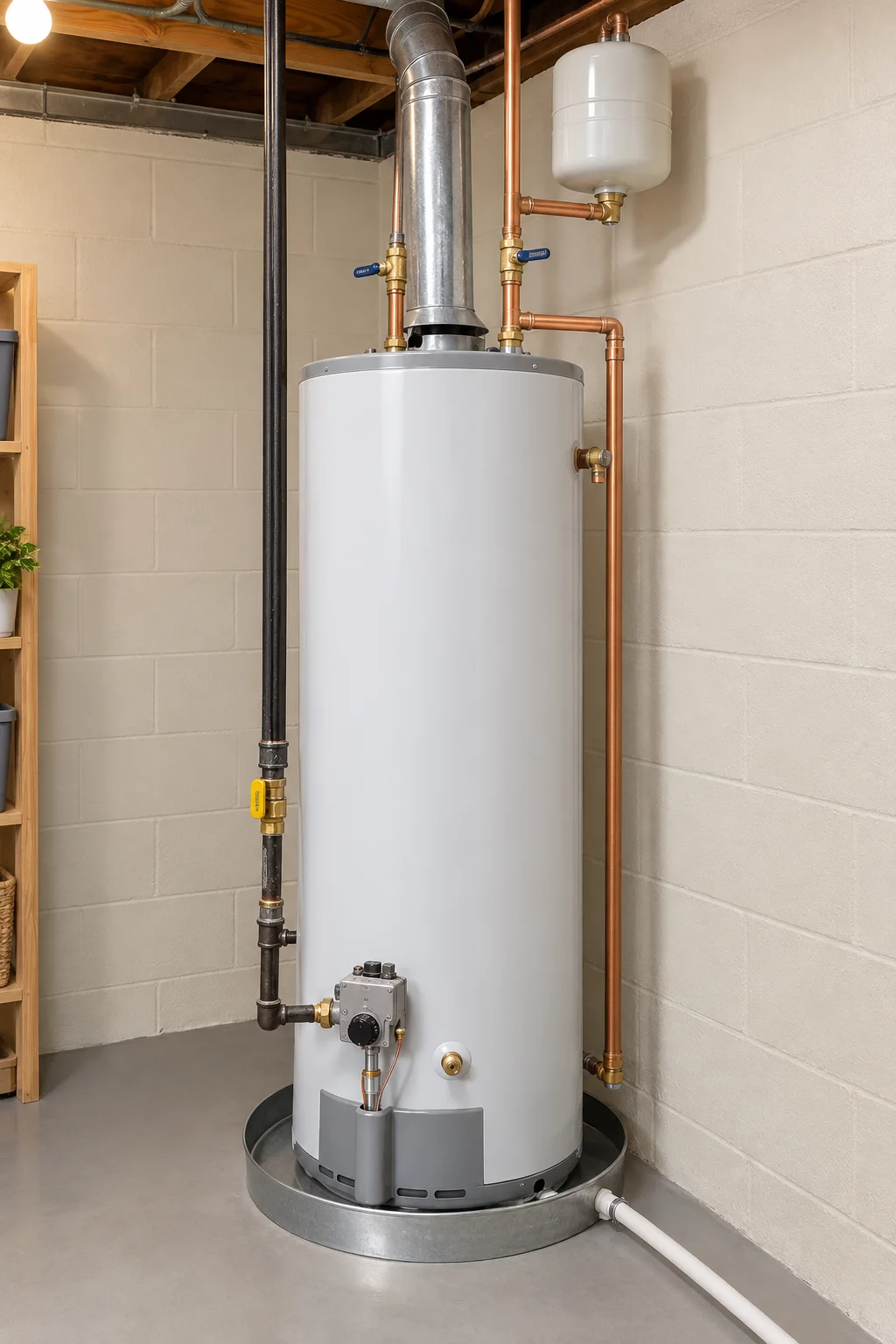
Measure the installation area and access path. Include clearances, service access, drain pan strategy, condensate for hybrid or condensing products, combustion air and venting for gas, and sound for compressor-based units. Confirm electrical and fuel capacity professionally. The appliance has to fit both the demand calculation and the building.
Keep temperature and safety separate from capacity
Raising stored or delivered temperature to stretch capacity can increase scald risk and is not a recommended sizing correction. Temperature settings and any mixing-valve design need professional consideration, especially where household vulnerability or local requirements apply. Never alter a temperature-and-pressure relief valve or its discharge arrangement.
After installation, review operating mode, controls, expected recovery, and signs that require service. A correctly sized system can still underperform if a component fails or maintenance is neglected. Warranty tank, heat-exchanger, parts, and labor provisions should be read separately; no universal warranty period applies to all technologies or manufacturers.
Frequently asked questions
How many people can a 50-gallon water heater serve?
There is no reliable universal number. Compare first-hour rating with the home’s actual peak-use sequence, fixtures, recovery, and incoming-water conditions.
What is first-hour rating?
It estimates how much hot water a fully heated storage model can supply in a high-use first hour, combining stored water and recovery.
What numbers matter for tankless sizing?
Realistic simultaneous fixture flow in GPM and the required temperature rise, checked against the exact model’s performance table.
Should I raise water temperature to get more capacity?
No. It increases scald risk and can hide a sizing, repair, control, or distribution issue. Seek a professional assessment.
Can slow hot-water arrival mean the heater is undersized?
Not necessarily. Long or uninsulated distribution piping and recirculation design can delay delivery even when production capacity is adequate.
Sources
ENERGY STAR Residential Water Heaters Version 5.0 Specification