Tankless Water Heaters: Flow, Temperature Rise, and Fit
Tankless water heaters are sized around heat transfer while water is moving, not a stored-gallon reserve. A useful plan starts with the required temperature rise and the gallons per minute of fixtures likely to run together. It then checks whether the home can supply the needed gas input or electrical power, where venting and condensate can go, and how piping distance will affect the wait for hot water.
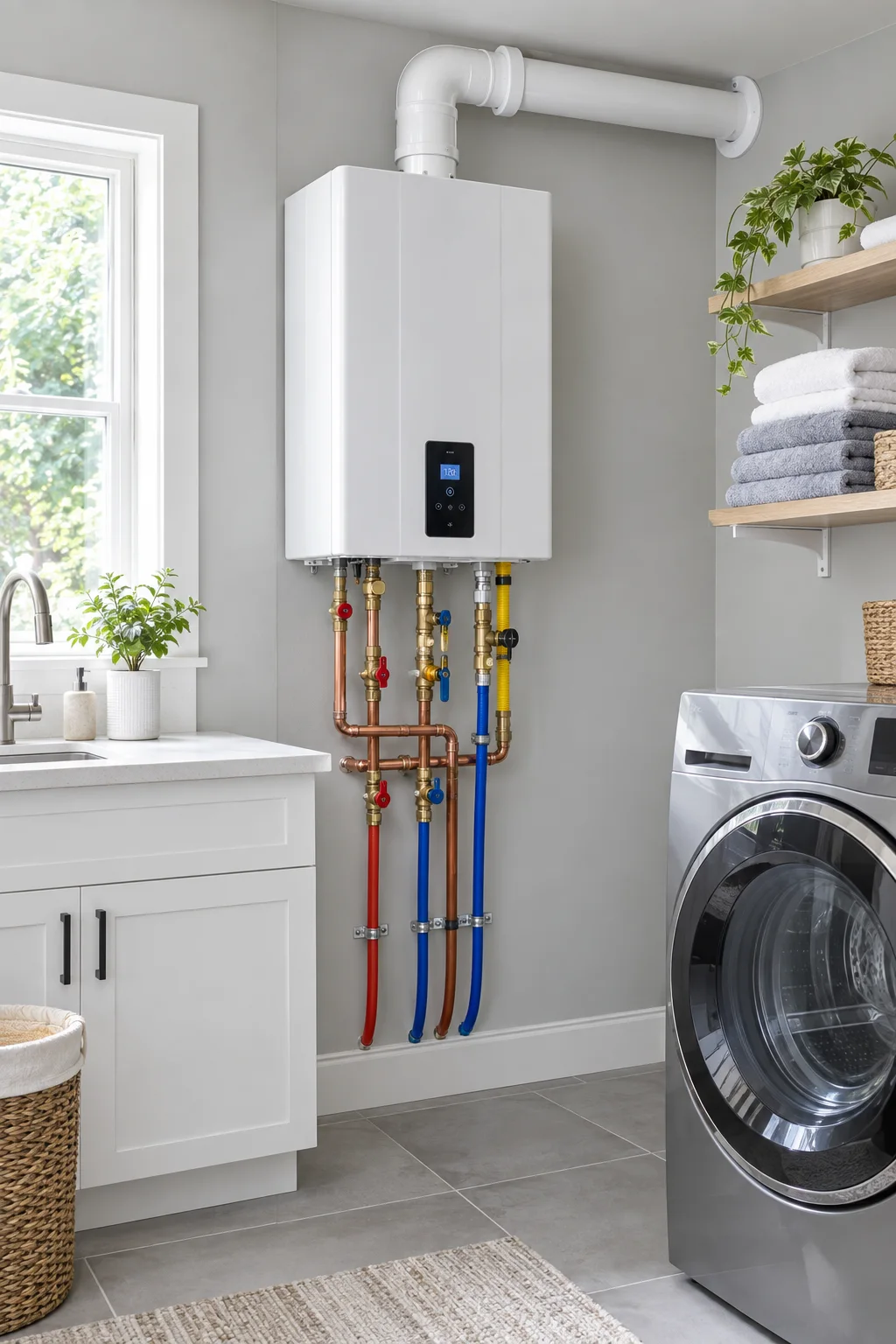
Flow is simultaneous
Add realistic fixture flows that overlap; adding every fixture in the house usually overstates the design event.
Winter inlet water matters
A greater temperature rise reduces the flow a unit can heat to the desired outlet temperature.
Infrastructure can decide
Gas capacity, venting, combustion air, electric service, condensate, and mounting space require verification.
Temperature rise turns GPM into a sizing question
Temperature rise is the difference between incoming cold water and the required hot-water outlet temperature. Colder incoming water creates a larger rise. Manufacturer performance tables show that available gallons per minute usually falls as required rise increases. A headline maximum GPM measured at a mild rise is not enough for a winter design.
Estimate plausible simultaneous use: perhaps two showers, or a shower and a kitchen draw, using actual or reasonable fixture flows. Then compare that event with the model’s output at the local design rise. The result is more defensible than sizing by bedrooms or headcount alone. Flow controls may reduce outlet flow if demand exceeds heating capacity.
Endless duration is not unlimited flow
A correctly supplied tankless unit can continue heating while demand remains within its capacity, but it cannot serve unlimited fixtures at once. Long use also continues consuming fuel, electricity, and water. “Endless hot water” should therefore describe duration within limits, not infinite delivery.
Tank models are evaluated differently. Illustrative 30-, 40-, 50-, 65-, and 80-gallon labels indicate stored volume, while first-hour rating combines storage and recovery. That comparison can help a household decide whether it prefers a reserve or on-demand production. Raising outlet temperature is not a safe fix for inadequate tankless capacity.
Gas and electric infrastructure checks
A gas tankless appliance can have a much higher input rate than the storage unit it replaces. Meter and regulator arrangements, pipe size and length, pressure, and simultaneous appliance loads require professional calculation. Vent category, approved material, equivalent length, termination clearances, combustion air, and condensate provisions must follow the listed instructions.
Whole-home electric tankless models may require substantial amperage, multiple breakers, and suitable service capacity. A panel with open spaces does not prove the utility service and conductors can support the load. Electrical upgrades and energized work belong with qualified professionals; gas piping and combustion setup are likewise not do-it-yourself work.
Waiting time, minimum flow, and recirculation
Tankless equipment does not make distant taps instantly hot. The cooled water sitting between heater and fixture still must move out, so pipe length, diameter, routing, and fixture flow shape the wait. A thoughtfully controlled, manufacturer-compatible recirculation design may improve convenience, but uncontrolled circulation can increase piping loss and energy use.
Units also have activation and minimum-flow behavior. Very small draws, rapidly mixed flows, or certain fixtures can feel different from tank delivery. Controls and crossover devices must be compatible. A site assessment should distinguish a production limit from a distribution delay before recommending equipment.
Water quality, service, and safe operation
Mineral scale can reduce heat-transfer performance, especially where water hardness and temperatures promote deposits. Follow the manufacturer’s inspection and descaling directions and discuss water conditions during selection. Inlet screens, condensate systems, combustion components, and venting may also require model-specific attention.
Warranty terms for the heat exchanger, parts, and labor can differ, with exclusions tied to scale, water chemistry, installation, or maintenance. Never service live electrical components, gas controls, venting, or a temperature-and-pressure safety device yourself. If gas odor is present, leave immediately and call the utility or emergency services from outside without operating switches.
Frequently asked questions
How is a tankless water heater sized?
By the realistic simultaneous flow in GPM and the temperature rise from incoming water to the desired outlet, followed by fuel, electrical, vent, and installation checks.
Will tankless hot water arrive instantly?
Not necessarily. Water already cooled in the distribution pipe must still clear, so distance and pipe design affect wait time.
Can tankless serve every fixture at the same time?
Only if their combined flow at the required temperature rise is within the unit’s rated performance. Every unit has a limit.
Can an electric tankless unit use my current water-heater circuit?
Do not assume so. Whole-home units may need multiple high-amperage circuits and adequate service capacity, which a qualified professional must evaluate.
Why does tankless equipment need maintenance?
Scale, screens, combustion components, condensate, and venting can affect operation. The exact schedule depends on the model and water conditions.
Sources
FTC: How to Use the EnergyGuide Label
ENERGY STAR Residential Water Heaters Version 5.0 Specification